
Saturday, May 15, 2004
Gang up
Steve Gillmor and Doug Kaye put up the inaugural Gillmor Gang at Doug's IT Converstions. We recorded it yesterday afternoon. Listen while it's fresh.
Close enough
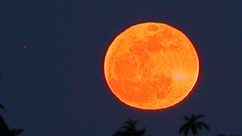
This here is about as full a Moon as you're gonna get, short of one eclipsed by the Earth's shadow. It's what we saw here in California after the moon came out of the full eclipse witnessed by folks on the other side of he world. By the time we could see it, the penumbral effects of partial shadow were gone; but the amber gel of atmosphere above Los Angeles produced roughly the same effect. The moon was an orange ball rising above a fringe of palms.
The new Nikon CoolPix 5700 did a pretty good job. What you're seeing here is a small piece of a 5 megazixel image from a fully extended 8x zoom (equivalent of what, 300mm or something?). Easy to fault, but not too bad.
By the way, the Space Station went exactly overhead last night, and we missed it, though we saw it the night before, low on the Northwest horizon.
If you live on the East Coast tonight, you'll see the thing either eclipse or slide quietly past Jupiter. It's pretty amazing, because you can almost make out that the thing isn't just a bright point of light crossing the sky. It has a shape, and features. It's like looking at a fair-size building 200 miles away. With binoculars or a fast-tracking telescope, you can almost make something out.
To see what's visible from where you live, check Chris Peat's Heavens-Above. It's a remarkable site, very handy even for nonserious sky-gazers. You have to register and log in with each visit; but it's free.
Speaking of sky gazers, Susan Kitchens has been looking down lately, and has a pair of political statements to make.
One of those is Reunite Gondwanaland! Well, not far from here, at the University of California at Santa Barbara (which is actually at the Santa Barbara Airport, which is in Goleta, which is next to Isla Vista, most of which is occupied by the University), researchers have arived at the tentative conclusion that Gondwanaland was whacked and cracked like an egg by a meteor at exactly the moment when we know for sure that most of Life on Earth came to an end. Geologically, it was the end of the Paleozoic era and the start of the Mesozoic; but there was a lot less 'zoic at the start of the latter than the end of the former.
The Great Dying, they call it. The Mesozoic Era was the Age of Dinosaurs. That one came and went with big booms.
This particular boom was delivered to a location off the coast of Pangea, a large fraction of which we now call Australia. It's name is Bedout, pronounced "Bedoo." The one that closed the Mesozoic and opened the Cenozoic (your Age of Mammals) is the less pronounceable Chixculub, invisibly buried under ocean and vegetation on the Texas-facing corner of the Yucutan peninsula.
Anyway, congrats to Luann Becker and the team at UCSB. And thanks to NASA and others for funding it.
Bonus link: A Correlated History of the Universe is the best one-sheet summary of all geology, all life and its correlated contexts that I've ever seen. A labor of love, knowledge and extreme detail work (not to mention patience) by the authors, it's worth the somewhat steepish $25 price. Highly recommended.
I suspect A Correlated History of Earth is also terrific. Check out the whole site.