
Sunday, April 25, 2004
The more things stay the same
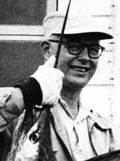 My father, pictured to the left there, was born in 1908, and was a teenager when radio took off, much like the Net did in the late 1990s, complete with the speculative boom. I remember Pop telling me about listening with a crystal radio receiver, which involved a coil made by wrapping wire around a cylindrical quaker oats container. (Good Lord, there's an entire society dedicated to crystal set radios.) The antenna was a long wire that went out a window. You tuned the thing by moving a wire called a "cat's whisker." Everything involved — coil, crystal, antenna, oat box — cost almost nothing. The one thing that cost serious money was the headphones. That's what we have here:

These are the headphones my father used. My father's younger sister, Grace Apgar, found these in her house recently and mailed them out to me. They're in remarkable shape, considering. I put together a gallery of photos of the things. Most of the following links point there.
On the back of each headphone, in raised lettering, is the legend "NATHANIEL BALDWIN / SALT LAKE CITY, UTAH / PAT. MAY 10, 1910 / SEP. 14, 1915 / TYPE C". So I looked up Mr. Baldwin and his headphones, and found his was quite a story. A pioneer farmboy who went to BYU and Stanford before returning to Salt Lake City to a life of invention, entrepreneurship and polygamy. These headphones were his most successful invention, and his legacy.
What amazes me about them is how little the form has changed, and how much modern headphones continue to express the original form. In fact, my Sony MDR-CD760 headphones feature a cable with a braided cloth sheath that recalls the one used by Baldwin. In doing so they eschew whatever transient wisdom possessed headphone makers when they used coiled cables, which inevitably degraged and turned into tangled messes.
The phono plug, now covered with copper oxide, is a Stromberg-Carlson that served as an adapter for the Baldwin's two pins. It must be nearly as old.
Anyway, much appreciation to Aunt Grace for sending me these. I think when I get back from Europe I'll make a crystal radio with the kid and see how well these things still work. Betcha they're fine.
[Later...] Grace just added this by email:
The radio had, on the lower left side, a little crystal.( in a round metal holder about a quarter of an inch wide) The crystal looked like a small-rough- textured piece of black coal. Attached at that point, there was a ( 4"or so) short piece of platinum wire that would be placed in various crevices in the crystal's surface - bringing in the different radio stations. I don't remember an antenna wire.
This was in Fort Lee, New Jersey, which is right across the river from Manhattan. The signals would have been pretty good. Here's a list of stations from 1925.