
Monday, March 26, 2007
Good to have, principles
JD Lasica: Principles of Citizen Journalism Project Launches. More here from Dan Gillmor. The principles are: Accuracy, Thoroughness, Fairness, Transparency and Independence.
More at all those links.
Not the end of journalism-as-usual, but you can see it from there
Fortress Hays is a new placeblog for Hays, Kansas, home to Fort Hays State, which is in turn home to an excellent geology department. (Here's its blog.) And professor Ron Schott, who has been especially helpful in assisting my own geolological explorations.
The latest post, appropriately, is Print Journalism in Crisis.
Not just deadly
Turns out term papers are dead too.
Mmmm, gaah
Al Nye points us to The Omnivore's Dilemma, which contains this tasty bite:
...perhaps the most alarming ingredient in a Chicken McNugget is tertiary butylhydroquinone, or TBHQ, an antioxidant derived from petroleum that is either sprayed directly on the nugget or the inside of the box it comes in to "help preserve freshness." According to A Consumer's Dictionary of Food Additives, TBHQ is a form of butane (i.e. lighter fluid) the FDA allows processors to use sparingly in our food: It can comprise no more than 0.02 percent of the oil in a nugget. Which is probably just as well, considering that ingesting a single gram of TBHQ can cause "nausea, vomiting, ringing in the ears, delirium, a sense of suffocation, and collapse."
The book also pionts out that a Chicken McNugget is 56% corn.
Another reason to envy Santa Barbara
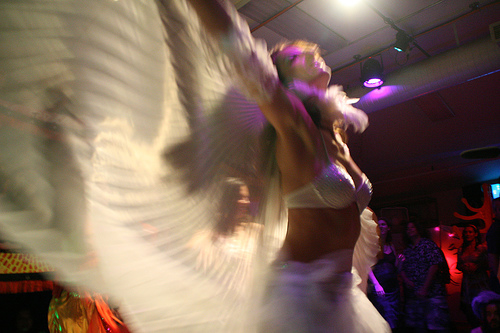
Santa Barbara is best known as a beautiful little beach city, a Hamptons for Los Angeles, with lots of celebs and retirees and college students clubbing lower State on weekend nights. It's also known as the place where the environmental movement surged forward, after its harbor was the first coastal victim of an offshore oil spill, in 1969.
What you might not know is that this is a very creative party town. The most public expression of this is the annual Soltice Parade, which is kind of what you'd expect to see on on July 4th if Wavy Gravy had written the Declaration of Independence.
Less public, but no less creative, is FishBoN, which specializes in "experiences" that combine dance, acrobatics, music, costume, sculpture, technology, architecture and many other art forms in a setting that's both a museum-grade art production space and Party Central.
They had one on Saturday. I shot it, and here are the results.
Among them is my own experience at creating the impression of light escaping from a box:
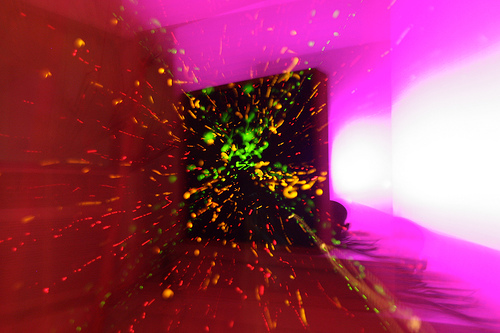
The box was a black panel with little lights that blinked with the music. Alan Macy had created it back in the 70s, and the back side of it is an assortment of old integrated circuits. And it still worked perfectly.
The Melting Piont
I don't know whether it's just an NCAA men's basketball finals thing, or if it extends to other sports (I'm sure it doe), but I've noticed for many years that there's this moment when you can tell a team is suddenly melting down. I saw it many years ago after we drove 17 hours from Palo Alto to Seattle to see Duke play Seton Hall in the national semifinals. Duke was favored and had a big lead when one of their players — Robert Brickey — went down with an injury. Duke melted immediately. Seton Hall routed them.
Sometimes it happens right before the end of a game, as it famously did in 1982, when Fred Brown of Georgetown passed the ball to James Worthy, giving the national championship to Carolina. It went Carolina's way again years later when Chris Webber of Michigan called for a time out when there were none left, turning the ball over and the game with it.
And it happend yesterday when Carolina was up by about 10 and Georgetown scored an easy layup off a back-door pass. I said to The Kid, "Georgetown is going to win this. Carolina has just begun to melt down. You can see it." And they did. It was awful. Carolina would have been lucky to have lost in regulation; but the game went into overtime, which was five minutes of straight hell for the Tar Heels. Georgetown scored at will while Carolina took one desperate doomed shot after anther. When Tyler Hansbrough went to the line for two foul shots near the end of the bonus period, I told the kid "He'll miss them both. Watch." Bear in mind that Hansbrough hadn't missed a foul shot for the whole game up to that point. He'd hit something like ten in a row. But he clanged the last two. It must have pained Roy Williams to look at the faces of his kids and know there wasn't a damn thing that could be done. They looked like This Can't Be Happening, which is the worst look in the world for a team like that to have at a time like this. You've got to go calm and find deep reserves of Resolve and other stuff like that. They didn't have it. Georgetown did.
Gotta like Georgetown. Impressive team.
[Later...] I see Hansbrough quoted in the paper this morning saying the problem was that the team's shots "just didn't fall". Well, yeah. But Basketball is a game of psychology as well as skill. Georgetown got into the Tar Heel's heads — enough so you knew the Heels were going to lose, long before it happened. So did the Heels. And so did the Hoyas.
Sick is the new dead
Declaring live stuff dead was old long before techies picked up on the practice. It's always been the fashion thing to do. I've done it myself. I believe I've declared PR and advertising dead. Marketing too. Also brands. I'm not sure, but it hardly matters because all the above are still alive and will probably continue thriving long after I'm dead.
Currently awake for its autopsy is the newspaper business. Naturally, there is debate about the matter. Scoble says Newspapers are dead. So does Stowe. Brian Solis says Journalism is not dead, but Newspapers are dying. Matthew Ingram says Print may be dying but the news is not. Mark Evans (and many Scoble readers) say Scoble, You’re Wrong: Newspapers Aren’t Dead. Mark provides numbers to back his points. (Of course, there are doomy numbers out there too.) Larry Borsato says Don't Count Newspapers Out Yet.
Back in October Tim Rutten of the LA Times pointed out that his paper makes good money — just not enough to satisfy Wall Street, which demands relentless growth. (I'd quote more than you see at that link, but the rest of the piece has scrolled behind a paywall so fuggit.)
For what it's worth, the Sunday LA Times that lands in our driveway has the heft of a log and could be used to chuck a truck tire. It's a huge pile of editorial and advertising. Whatever else it is, the mother does not look dead to me, mon.
Yet Warren Buffet (a man you would not want to bet against on matters of money) wrote last fall that "fundamentals are definitely eroding in the newspaper industry" and "the skid will almost certainly continue".
Whether or not newspapers die (and some surely will), we are growing a new and larger understanding of What Journalism Is About. And it's a lot bigger than newspapers, whether they live or not.