
Wednesday, June 23, 2004
And don't forget it
Britt Blaser: Memorable conversation is the foundation of civilization. He also has a cause: Spirit of America.
Ourdentity, cont'd
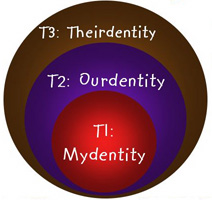
In Re-ID, Ross Mayfield picks up on what I wrote here (pivoting from an RSS-as-authenticated-email idea), and adds much more, starting with this:
There are a number of ways to look at relationships. One is ties in a social network. If you plotted a graph of directional ties using email and and one using RSS they would be different, perhaps even the opposite. Email ties would point from Sender (A) to Receiver (B), a Push Model. RSS ties would point from B to A, a Pull Model. If enough positive message flow exists between A and B you can imply a confirmed tie with either Email or RSS which is an indicator of a relationship.
Both message formats are simply conduits that get stuff between A & B. They share a common problem of writers thinking their words are more important than reader’s time (my ego is doing this to you right now and you are wishing I could give you a simple bullet point for your mental outliner). But there is something different about the Pull and Push Models.
He concludes,
...the deepest question I am wrestling with on identity is in social networking. When a composite identity is formed in a network without your participation. Your friends upload your contact information to make you a node in the network, your emails with them and information scraped off the web builds an identity that you don’t own or control.
A Composite Identity isn’t Personal, Corporate or Marketing. I asked Doc about this and he thought it may fit into Corporate identity extended to individuals as corporations. Eric Norlin of PingID define Corporate for me as "identity that takes place in a shared context." But there are individuals intermediating with the corporation to form the identity. The individual being identified isn’t sharing this context. There is re-course to the corporation hosting the network that will allow you with some effort to have your node removed. Marketing identities are abstracted from data gained and put you into segments, but this is networked marketing and relationship-based. I believe that a Composite Identity represents something new, potentially scary, that fits somewhere between Corporate and Marketing identity, perhaps a fourth Tier.
In other words, there are second person singular yourdentities derived from social processes that are not first person plural (ourdentity) but rather third person plural (theirdentities), which are not represented in any of the current abstractions. These identities are answers to the question "Who am I?" that only others answer.
It's a long, thoughtful post, based on real-world experience by a thinker and businessdude who's trying to make sense of a matter that matters. A lot. Read the whole thing.
Also read Adina Levin's Does RSS Replace Email?, which Ross sources as well.
There's also some possibly helpful (but increasingly mossy) background in my talk at DIDW last Fall.
A hmmm: Maybe we need a Venn diagram here, rather than a set of tiers. Let's think about that.

We're sorry. You've heard too much. Please understand this is just business.
Corey Deitz: RIAA Claims Music On Car Radios Meant Only For Original Vehicle Owner!!!!
More like a volcano
Trudy Schuett: The Ethics of Reviewing Or Promoting Products On Your Weblog. Also on her main blog is a pointer to TheNewPR/Wiki and Media Culpa, which points to this Newsweek story about Oh Yeon Ho's OhmyNews in Korea. An excerpt:
The initial premise is conventional: OhmyNews employs 25 trained reporters who cover the major news stories of the day. But the twist comes with another 10 editors who review and post as many as 200 articles written daily by nearly 33,000 "citizen journalists: — anyone who registers can submit a 750-word piece in exchange for a few dollars per story. If the article makes the "Top News" section, the payout is about $11.
Trudy also points to this item by Griff Wigley about "hyperlocal" news coverage by citizen bloggers in Minnesota.
Read on for more proof that there's something more than a journalistic groundswell going on out there.
Bonus link #1: Chris Nolan: It's Not Just Blogging Anymore.
Bonus link #2 from William Gillis: The Internet invented free speech.