
Monday, January 16, 2006
On the continuing end of civilization as usual
Ed Cone: The sense of what is appropriate behavior — the sense that there is such a thing as appropriate behavior — is diminishing across our culture. Considering what other people will think has been replaced by a reflexive recitation of one’s rights to do as one pleases.
Then again, the most viewed of all my pictures on Flickr, the one four people call "favorite", is this.
Dreaming still
Bret Fausett offers Martin Luther King Jr.'s I Have a Dream speech as a podcast. It never gets old, he says. Listen to it again.
Here's the text. Still, listen.
I was a Junior at Guilford College in Greensboro, North Carolina, when Dr. King was murdered. He was still a young man: just 39 years old. He was 33 when he made that speech.
I arrived at Guilford in 1965, just five years after the sit-in movement began when four students from North Carolina A&T sat at a segregated lunch counter at the downtown Woolworth's. There was no shortage of "unrest" then. During my four years in Greensboro, the city was curfewed a number of times, as the National Guard was called in to keep the peace.
And black folks had plenty to protest. Thirty-five years later, everybody still remembers Kent State. But few today remember the black students shot by police gunfire in Orangeburg, South Carolina. Three died, and more were wounded.
And few outside Greensboro remember Willie Grimes, the student killed during conflicts that spread from Dudley High School to NC A&T, and involved local police and the National Guard. (Here's an interesting report from the News-Record blog.)
That death stands out for me because it was emblematic of the grief, hopelessness, despair and anger that followed the murder of Martin Luther King.
Listen to the Dream speech, and hear the hope it brought to people of all races. That hope was real. That hope lifted a nation. That hope moved civilization forward.
The Dream speech was dawn. It was light. It promised freedom. After that speech, many more people fought for that freedom, most effectively without violence, as Dr. King had taught them. I was one of those people.
The cause of freedom, of nonviolence, of peace, of opportunity, of so many good things people can bring to each other, was shot along with Dr. King on April 4, 1968. The setback was enormous, incalculable.
After Dr. King was murdered, Robert F. Kennedy gave a brilliant speech in Indianapolis that almost certainly saved lives in the riots that broke out across the U.S. On June 5, Kennedy was shot and killed as well. That fall Richard Nixon was elected President.
Thirty-eight years later, the dream still lives. Maybe, if we keep listening, it will become reality.
[Later...] One reader observes that the linked file (here) won't play on her computer and wonders if it's because, as Tech Law Advisor points out, in a trackback to Bret's orignal post points out,
"The Eleventh Circuit Court of Appeals ruled in 1999 that [Martin Luther King's "I Have A Dream"] speech was not "generally published" for purposes of waiver of copyright, and that the King estate had the right to enforce its copyright in the speech." I Have a Dream (C), Likelihood of Confusion, Jan 18, 2005.
[See: Wikipedia entry on the case and the decision]
See also: Martin Luther King Documentary Unavailable Due to Copyright Issues (Jan 17, 2005)
I dunno. The file plays for me just fine, both in the browser and as a downloaded .mp3.
Still, if you follow those links, it's an interesting story.
Bonus link: Leanord Pitts Jr.'s column.
No sooner not asked than done
One of the mystery scenes I shot from the sky over Los Angeles last Thursday was this one:
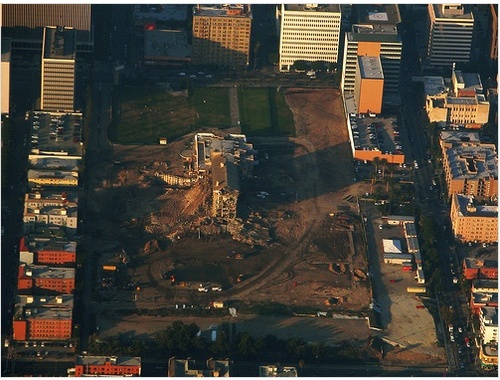
I had meant to ask if anybody knew what that was — something quite large was clearly being demolished, though some of it was also being preserved.
Now, thanks to this post on the Ambassador's Last Stand blog, I know. It is (or was) the famous Ambassador Hotel at 3400 Wilshire.
According to this page here,
Only a few small parts of the hotel will be preserved - the Coconut Grove will become the school's main auditorium, a Paul Williams-designed coffee shop will be turned into a teacher's lounge, and parts of the Embassy Ballroom where Bobby Kennedy gave his last speech may be preserved as a library.
In all, there will be three new schools built on the site of the Ambassador: an elementary school (scheduled to open in in 2008), a middle school and a high school (scheduled to open in in 2009).
I guess that's the Cocoanut Grove, just above the middle of the shot. Hard to tell, though. The whole thing looks pretty forlorn.