
Saturday, February 7, 2004
Greater Blogistan
Thanks to Clay (and many others) for pointing to The Technorati-Sphere. It's by The Politburo Diktat, which sourced the Technorati Top 100. Also dig the Commonwealth of Blogosphere States (within which Reynodssia predominates).
The rising tide
Yesterday I got up at 3am and took a shower. My wife calls showers my "positive ion treatments," because I almost always come out energized with insights and ideas. At 3:20am, mine was this: We need to take the long view on the current primary season. Even though we can't.
I didn't have time to write about it. Still don't. So I'll point back to The New Vernacular, an editorial I wrote three years ago for Linux Journal. In it is an illustration borrowed from The Long Now people:
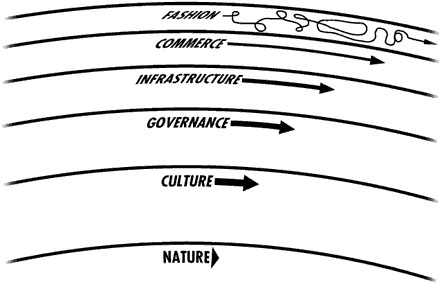
It's a description of civilization, and how it changes. Nature changes slowest, fashion fastest. Also, each faster layer sits on the slower one beneath: Culture on Nature, Governance on Culture, Infrastructure on Governance and so on.
Note where govenance sits.
I submit that the Internet is a Nature-level change in civilization. It sits beneath everything. And therefore it changes everything, starting with culture.
That's what we're seeing right now in politics. Our political culture now includes warbloggers and peacebloggers, techbloggers and pressbloggers — and citizens writing by the thousands in the Dean campaign blog and feeling terribly involved in the process. Which they are, because they're also giving money to the campaign. I see that the "failing" Dean campaign raised another $1 million in the last two days, including the campaign's second-best fundraising day ever. And that's just looking at blogs. Lord knows how many other ways the nature of the Net is changing the culture of politics.
Inevitably, this nature-changed culture will change governance as well. And everything above it.
Meanwhile, the press, which cares mostly about what's happening today, looks down from the level of fashion through the unavoidable filter of commerce and tries to make sense of it all. Bloggers work on timelines that are momentary and often impulsive.
Yet some of the sense-making is extremely good. Clay Shirky's Exiting Deanspace is a landmark essay. Dave Winer's Howard Dean is Not a Soap Bar shows how all candidates can use new technology to route around the failings of the (increasingly less) major media. Jay Rosen's Voices at the Crash Site Say the Frontrunner Was Never Ahead is an excellent summing-up of unconventional wisdom about What's Going On (be sure to read the comments too).
The common thread, not that obvious, is a call for The Long View.
Yesterday I told L.A. Times reporter Joseph Menn (whose book I plugged yesterday) that Dean's is a wave on a rising tide. That tide will continue to rise, whether or not Dean's wave reaches shore.
[Later...] Joseph's piece, in this morning's paper, is Dean Backers Debate Internet 'Echo Chamber'. It begins,
The near eclipse of former Vermont Gov. Howard Dean's presidential campaign is prompting some painful self-examination by a cadre of Internet intellectuals whose early enthusiasm helped attract tens of thousands of volunteers.
The loose-knit group of academics, software writers and online commentators have identified a range of factors responsible for the campaign's stumble, from the actions of Dean himself and former campaign manager Joe Trippi to those of the media establishment.
Quotage from John Perry Barlow, Dave Winer, Clay Shirky, David Weinberger, Larry Lessig, Michael Cornfield and yours truly. Funny, but I forgot uttering the quote that closes the piece:
He's the Wright brothers' first airplane. You wouldn't want to put passengers on it. But that doesn't mean it isn't important.
[Later...] Nice response to the LA Times piece by Dr. Weinberger in Loose Democracy.
The echo chamber meme distracts us from the true echo chamber: The constellation of media, especially in the US.
Goodness
Bunch of emails this morning pointing toward people doing good, one way or another, in the world.
There's Glasses for Humanity, a new effort that will route used eyeglasss to needies with the same prescriptions.
There's Jimmy Carter's blog (yes, they call it that) from Africa, where he's addressing the Guinea worm problem, about which I had never heard before. Web log will trace African Journey is a story about the blog in the Atlanta Journal-Constitution.
Among commercial ventures there's Magnatune, the online record company whose slogan is we are not evil. The company is up for a deserved award at SXSW, which is a great conference I'll hate missing for three years in a row. There are some good articles about Magnatune in Linux Journal, Wired, Corante and Blogcritics.